My Friend Should Sell These!

on 10.28.2009


I keep urging him to, but as usual he just brushes it off as a hobby.

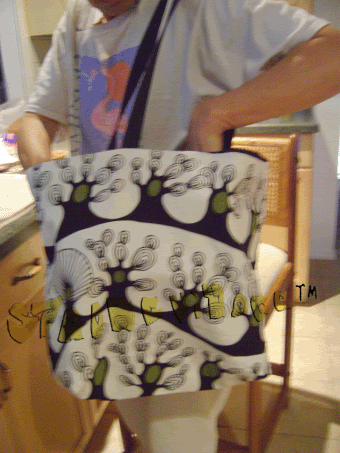
So much quality & love goes into the production of these bags, it's a shame no one else but me will be the recipient of these high-quality totes (v_v,)


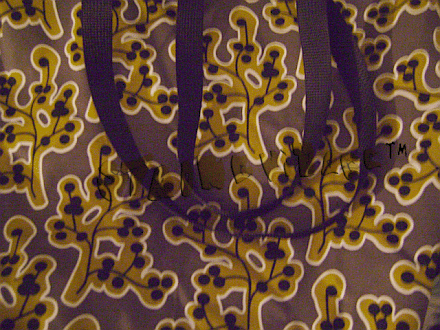
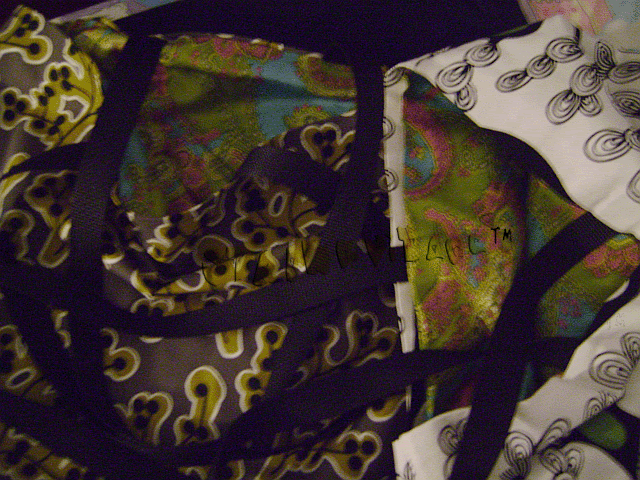
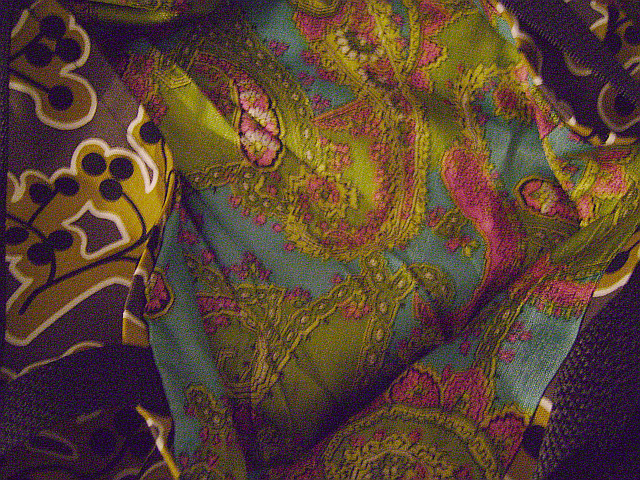
He used tough nylon fabric that sells at Ikea®. About 20" across and just as deep. The interior lining uses vintage polyester fabric.


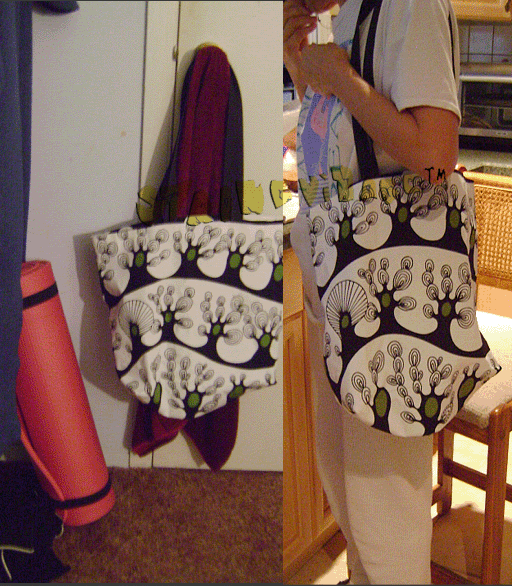
And pictured below my mami sporting it to give you an idea of how it handles:

About the size of that rolled-up yoga mat.

Nothing more that I LOATHE than 2C to see good talent go to waste! I know he'll be reading this post so perhaps you guys out there could urge him to sell these beauties into the marketplace?

It'll carry more weight if you guys say it. Cheer him along in the comments section!

Garment Print

on 10.26.2009
If you're ever getting tshirts made, read on...


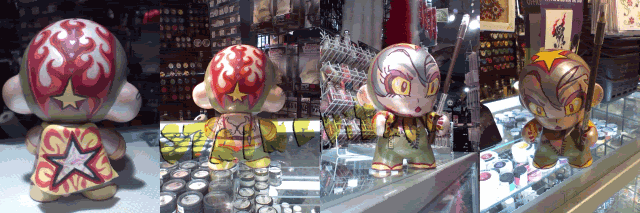
In my earlier posts, I put a picture up of my very first customized Munny. For those of you who don't remember, it's in the picture above. Then I decided I wanted a matching shirt promoting my custom Munny. So!

A while back, I had a temporary stint at a Tshirt shop and I was in charge of the garment printer. I learned a hell of a lot in that short time I was there.

There's many different shirt printing methods, but I totally praise the garment printer. I'm even addicted to it. It must've descended from Mt. Olympus upon us lowly peons...ok I jest.

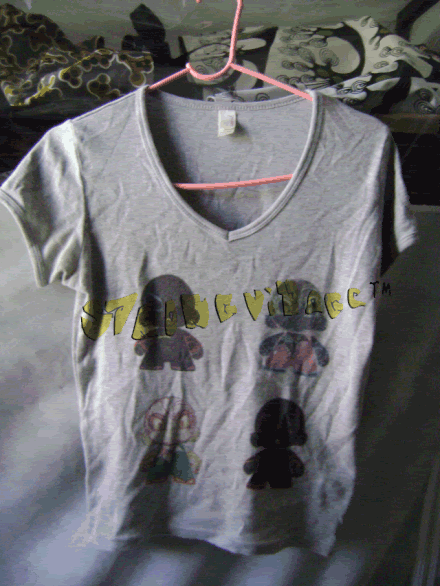
I will show you an example. I finally made that drawing of my custom Munny and ran it through the garment printer. Here's the finished product:

I colored each of the four dolls in different colors so you can get a feel of how they print out.

Here I used an Anvil® V-neck shirt, thin enough for summer wear. The cloth had no problem soaking up the ink perfectly. I slipped the shirt onto the plate, raised it (there's a lever underneath to raise the plate for shirts; lower it for thicker garments) hit the print button and voilá!

✚A garment printer is like a bigger version of a regular ink-jet printer, only it's specifically made for shirts.

✚Like a regular printer, it uses the black/ cyan/ yellow/ magenta inks.

✚There is no white ink of course
, so any white color in the digital file shows up as absent from the printing process.

✚Clearly you can't print on black shirts with it. That's like printing black letters on your home printer on top of black paper.

My only complaint with garment printing is that the machine we used didn't come with any kind of software. (major FAIL)

Software in this case would help VERY MUCH...

We used a Brother® brand which I loved, but the plate doesn't have any guides to help you align the garment so you have no freaking clue where the print area starts and ends. We ended up eye-balling and guessing how to align which should never happen in a busy-busy-busy shirt shop, especially with pricey machinery!
This is where pre-made digital shirt templates would've helped big time. Our printer was made to work with Adobe & Corel software, probably more types; I don't know, but it leaves to the imagination where your design will land on the shirt. Not good.


✚You think, that the machine knows how to read your digital drawing and calculate where to begin printing so that the image comes out perfectly. IT DOESN'T.

✚These machines DO NOT HAVE GUIDES. We have to guess where to lign up the garment.

I ruined many tester shirts and a few good ones trying to get it 'just right'. Printouts ended up far too high on the shirt and left a good 1 foot of blank space along the bottom. Or, the image was waaay below the neckline, or too close to the left armpit, hardly centered, blah blah blah...

✚If the last person lowered the plate and forgot to reset it to the standard position, the ink will smear all over the tshirt or whatever thin garment is loaded on the plate.

✚There's no way of knowing the plate has been lowered until it's too late: the adjustable lever is underneath the plate.

✚The plate is about, hmm, waist-high. So what are we supposed to do, bend down on our knees each and everytime to check before each run???(DESIGN FAIL)

Customers do not pay for shirts with mistakes on them either. Really not good.

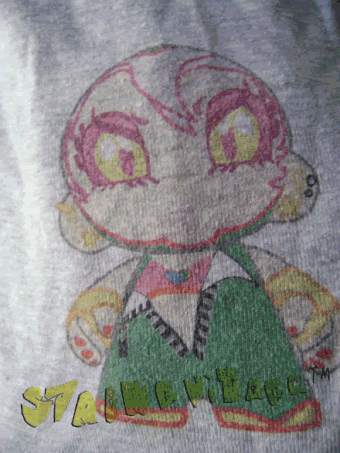
But the print quality is SUPERB. Here's a close-up. Looks like my Munny, right? :


And to the right, a zoom-in of the inked fabric.
The ink soaks through the fabric, leaving it soft and pliable.

Unlike professional screenprinting, where the most popular method involves letting the ink generally sits atop the fabric.

✚That kind of ink is actually a product called Plastisol, which is like hot melted plastic, and colors are later applied on top of that after cooling.

✚Plastisol is most useful for applying white and pastel colors to name a few.

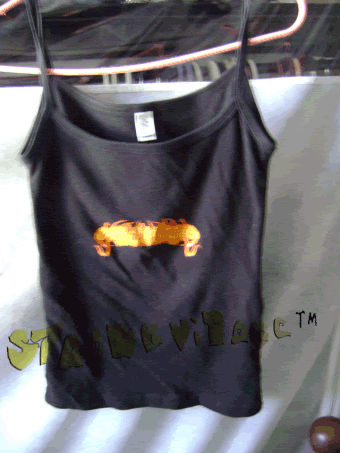
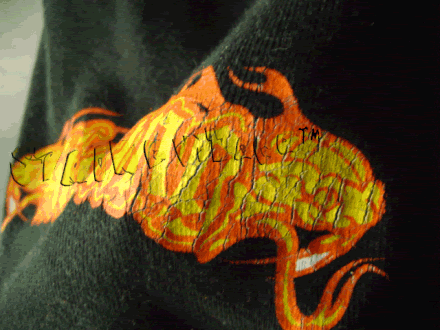
Here's a good example. This shirt I've had since 2003? It's from the Billabong line, it's a Plastisol graphic with the yellow and orange colors tinted over it:

This is an American Apparel® Classic Girl tank.
You can see that the graphic has crackled after a few years and many trips to the laundromat.


I always prefer the garment print 10-1. Color comes out slick and even fine lines show up, but not light colors. Light colors come out looking washed out and faded. For that, I'd go with the Plastisol. But for my very first professionally printed shirt I have to say I did a pretty decent job☻

I Gave Birth To This Sewing Abomination

on 9.13.2009
Kawaii♥!


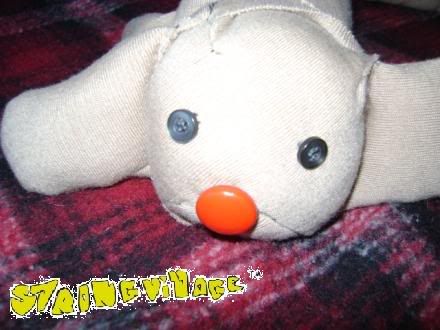
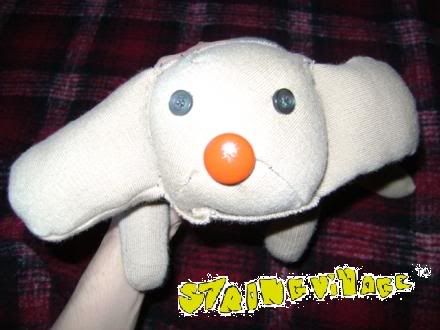
I did this sorta askewed stuffed animal while I completed my tailoring apprenticeship. When I started it, I had no idea it would come to resemble a weiner dog.

And then I thought maybe it could double as a sorta blowup doll for my dog back home. But he's just as neutered as Hugh Heifner on a Ritalin choo-choo. So I refined this fabric masterpiece and this is how it turned out:

Flying Doggie!


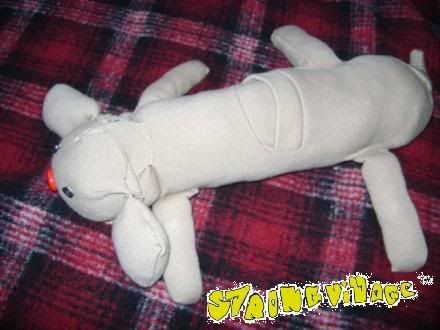
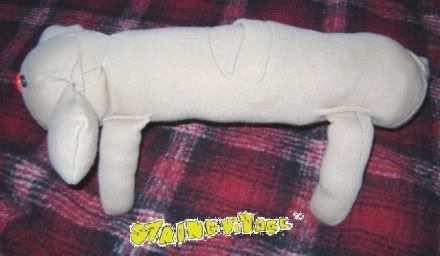
Full Length View


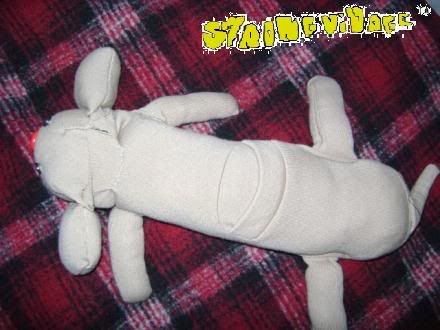
Top Dog


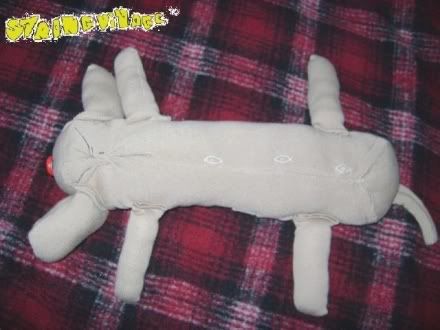
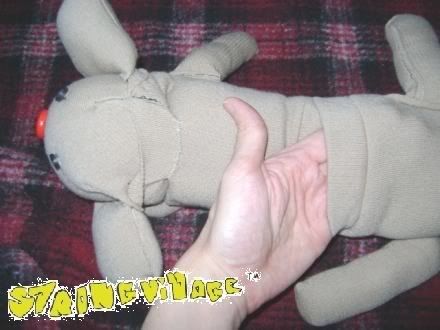
Under Dog✩ (Talk about recycling...did I mention it was made from an old sweater from Goodwill?)


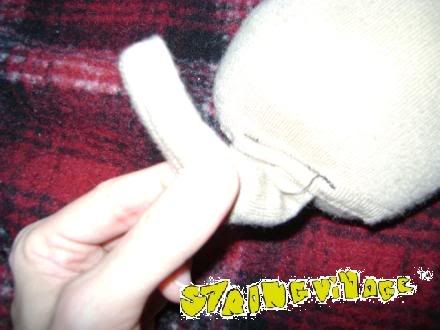
Closeup of tail finishing


I feel dirty! No redrocketing here folks!


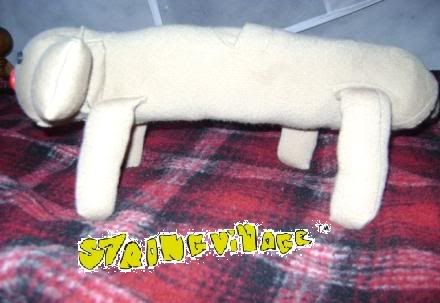
Stand up! Good boy!


We have the technology to rebuild him...


It took me 2 hrs to make this bad boy, plus 5 min to hand-sew the buttons on.

Boy-o, using a sewing machine RULES! I once mended 5 pairs of socks and took me about 6 hrs. If you have the machine, by all means use it! Another thing that sucks about hand sewing? If your fabric is too thick you have to use a lot of force to push that needle thru. That's where a thimble comes in handy. But your fingers get tender in the end regardless.

Maybe next time I'll crochet a condom or something. More riveting updates L8TR!

Emo Room

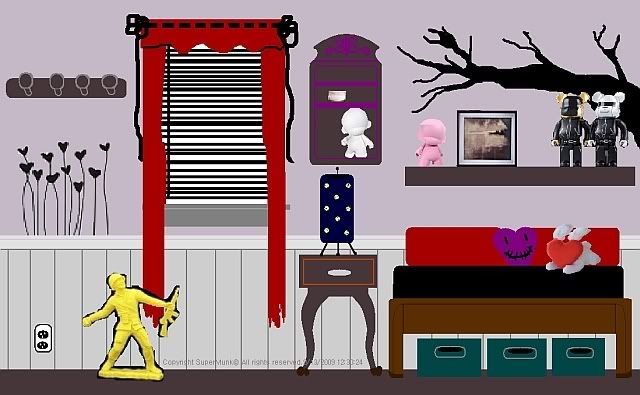
Before Twitter, Yahoo! Answers was my crack. I was on it earlier as I had a few ?'s of my own when I noticed someone asking for an emo bedroom ideas.

Then I drew this little diddy quickly. It's important to note when painting a bedroom, you have to use lighter colors on the walls if you have less than 2 windows. Light plays a major role in interior design. So here's my concept with one window:


Of course I cut & paste the vinyl toys & plushies. And there's wall decals on there as well. I am a fan of minimalism. Oh man, the things I could design with an unlimited budget! A girl can dream.

Sketchbook Diaries 1

on 7.29.2009


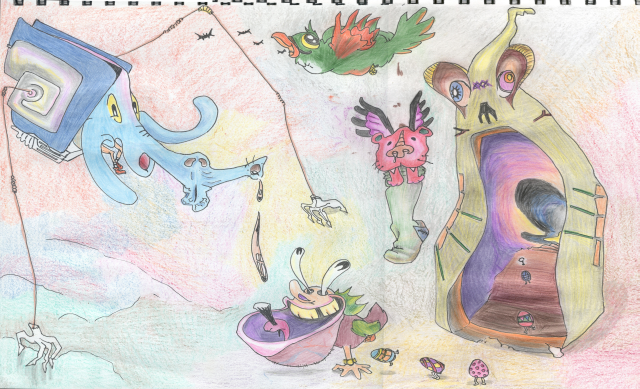
Roommate and I had a friend over one night. Needless intoxication ensued, along with hijinks and some episode about farting on each other's faces. I set taco shells on fire. Friend ran down the stairs with burning toaster oven. Good times, good times. Friend and I had a mini-drawing marathon/ Halo marathon. Somehow I came up with this and damned if I can remember what he drew.

My Anbu Soldier

on 7.18.2009

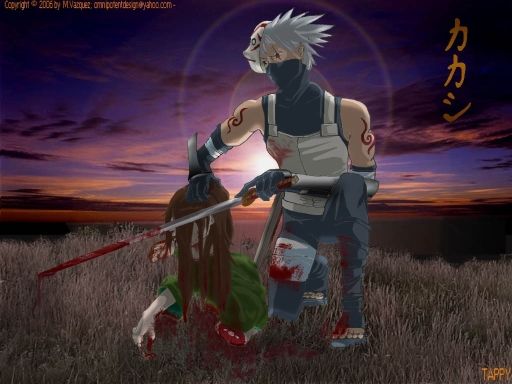
No secret I'm otaku, although not as hardcore as some anime-nazis I've met in my time ;-)

This drawing I am particularly proud of because it was done purely by imagination. No reference pictures whatsoever. Which means it took a buttload of hours to draw, especially cuz I'm indecisive about composition and poses. But I did have to erase a billion times over the drawing, now in one of my old sketchbooks somewhere in storage. (complete with eraser burnmarks!)

BTW, this was done with a mouse 3 yrs. ago during my pre-Wacom days. And yes, massive carpal tunnel ensued (>_<)


Making My Tshirts At Home

on 7.17.2009
There are plenty of tutorials out there for this kind of thing, and this isn't one of them.
Though if you ask nicely, I'll happily point the way towards some really good ones ;-)

I got the urge one night (ok, 3 nites and 3 shirts) to make my own shirt designs right here by hand. I constantly shift between computer art and um, human-powered art. Doing one or the other gets tedious and this time around was no different.

The biggest obstacles I face right now are that my studio space is in Jersey along with my art supplies. Even if I had them here, papi raises hell for even small infractions. Like leaving a sweater on a couch.

Heaven help me if I leave a sweater on a couch, in this nursing home of derelicts! Not only will I keep hearing about it over, and over, and get lambasted with it atop any future accusations, but have a lil' old man chirping in my ear repeatedly whilst circling and hovering over me. Interrogation tactics that would make even the KGB cry for their mommy. Makes anyone feel all stabby, it does :-P

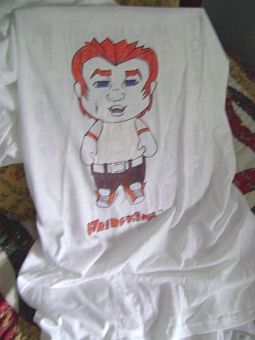
As a result, much of my art has been reduced to digital. Luckily I found my Japanese toxic marker pens that write on anything (leather, vinyl, fabric) and found some blank Hanes™ Tshirts and got the hell going on that there hizzy:

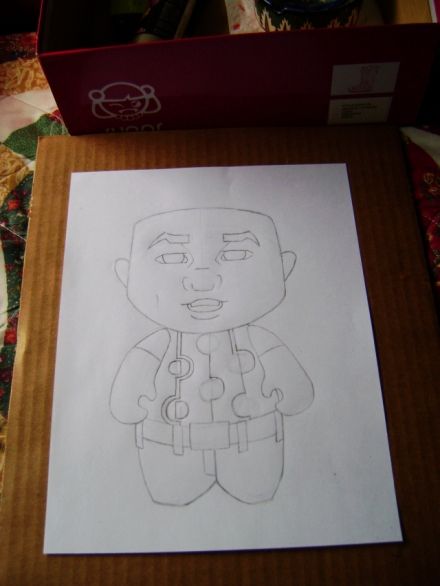
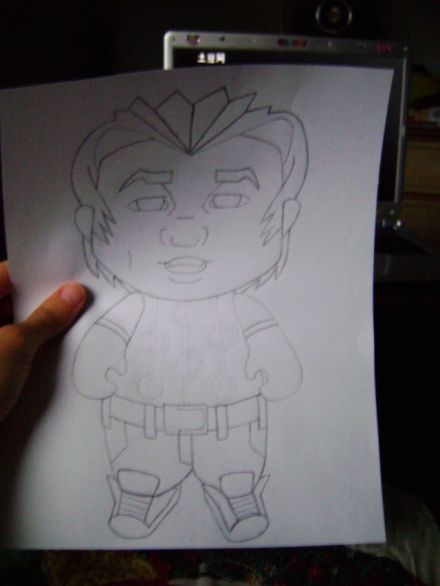
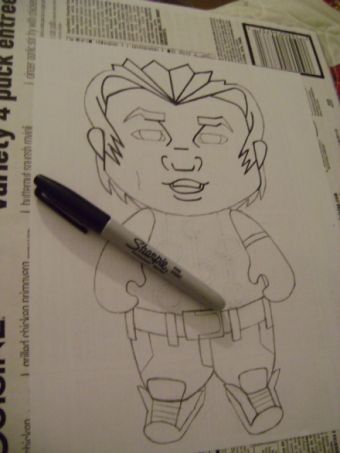
As you can plainly see, I began drawing on printer paper and taped it with drafting tape onto corrugated cardboard backing (my clipboard dissappeared). The drafting tape part is important. It makes peeling off super easy and holds strong. And for the drawing, a regular #2 pencil and Sanford™ Eraser Stick.

Above you can see the finished sketch, complete with a multitude of erased-over indentations. Kinda sloppy, so I remedied this by printing out a copy on my All-In-One printer, at full dark.
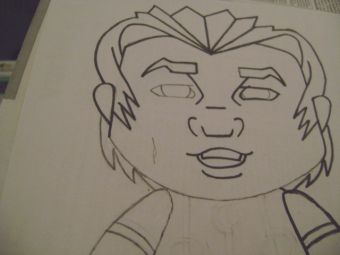
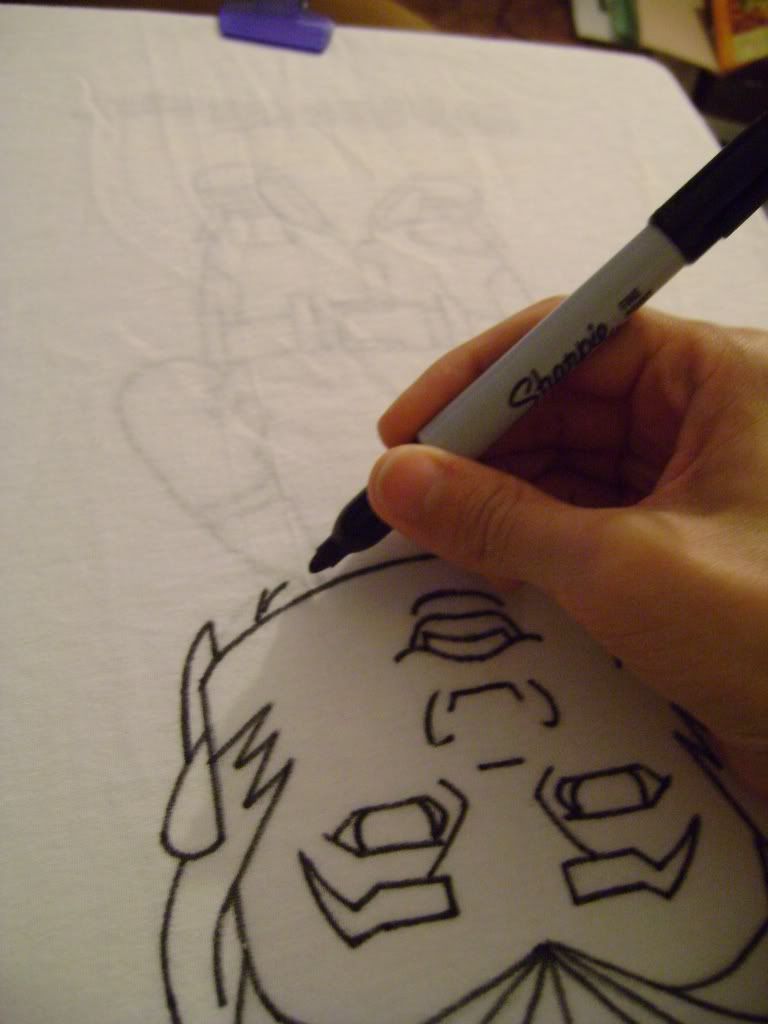
That printed copy I then traced in black Sharpie™ marker:

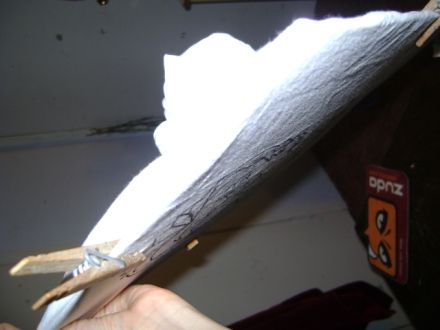
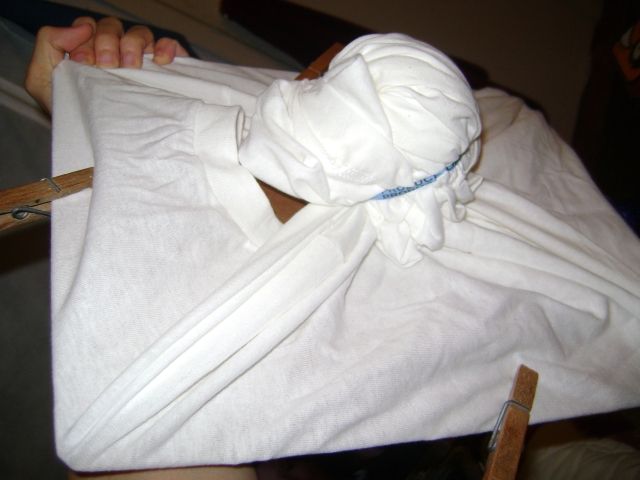
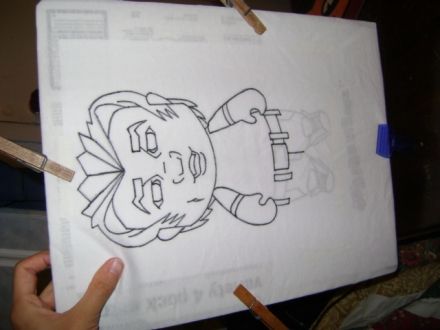
Next, as soon as I finish I tape onto the cardboard and slide a blank shirt over it. That shirt is then affixed to the cardboard to prevent sliding around as I draw over it with the paint marker.

See what I mean? Zoom shot!


And here are some angle shots of how I affixed the shirt in place:


Here I am drawing over the shirt (with Sharpie first), which covers the drawing I am tracing:


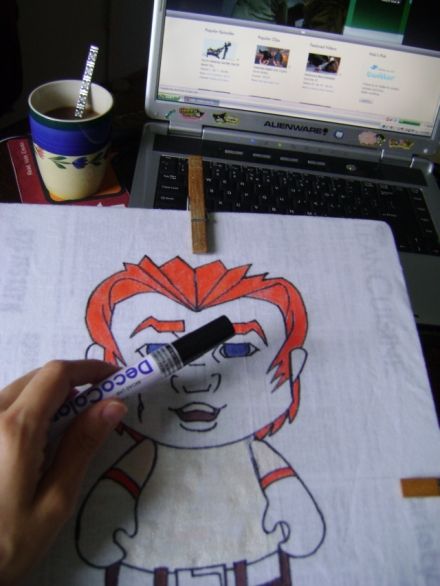
Here you can see the kind of paint marker I use over it, and the final result:


I should mention that although I made this shirt for a friend, that friend wears a size Medium in men's. All I had was XL to work with, which explains the extra tightening of the rubberband in the back. Also explains why the graphic seems small in the center. But he knows his way around industrial sewing machines, so it won't be problematic resizing it.

The drawing is a chibi of my friend; meet Poundcake!